A decision worth making sits in review for six weeks. A committee is formed, comments are gathered, two meetings are held. When approval finally arrives, no one can say which person was authorized to make the call, within what limits, or on what authority. The organization did not lack review. It lacked a delegation of authority: a record that connects each decision type to a named role, a stated limit, and a defined route upward.
The pattern intensifies as organizations grow. Authority that worked informally at fifty people diffuses across functions, geographies, and meeting structures precisely when decisions become consequential. Approval multiplies and ownership dissolves. Decisions slow, and when they are later examined by a board, an auditor, or a diligence process, the record shows discussion rather than decision.
1. Committee input is not decision ownership
A committee can advise, review, challenge, or endorse. Participation alone does not confer decision authority. A committee may hold formally delegated authority, but its mandate, limits, decision rules, and recordkeeping must be clear. When authority is assigned to a group without those elements, three problems can follow. Latency rises with stakes: the more consequential the decision, the larger the group that convenes around it. Accountability becomes difficult to trace when no one is responsible for recording and implementing the outcome. And the approval itself loses meaning when its scope and limits are unstated. Committees are useful. They are not a substitute for an explicit delegation.
2. Delegate by decision type, not by title
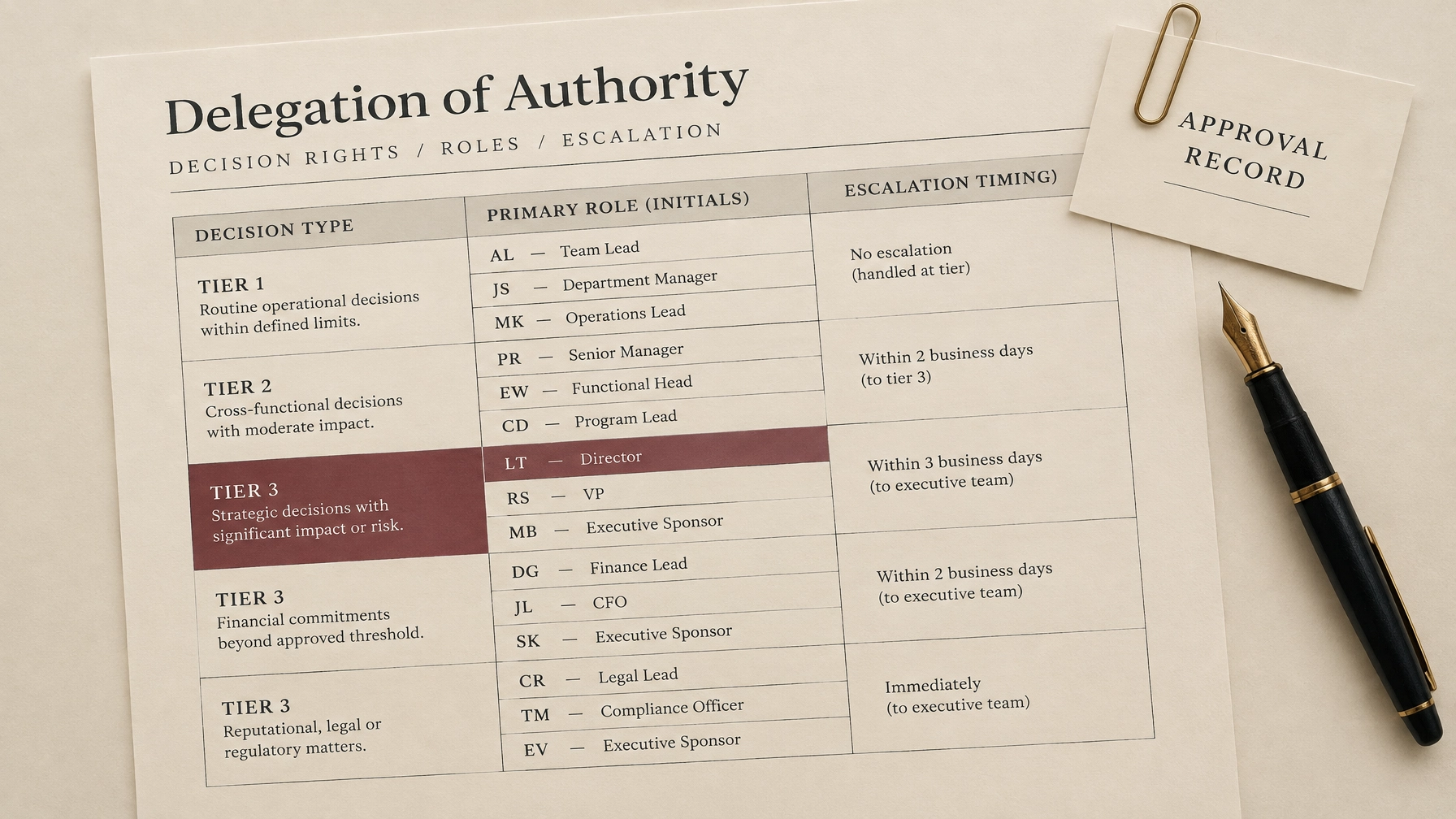
Effective delegation starts from the decisions, not the org chart. The recurring decision types are stable across enterprises: financial commitments above a threshold, contract execution and liability terms, responses to regulator inquiries, personnel and conduct actions, suspension or restoration of an operation. Each type maps to a named role with stated limits: amount, scope, duration, conditions. A responsibility chart shows how work divides. A delegation of authority states who holds power to commit the organization, and to what boundary.
3. Boundaries and escalation triggers make the delegation operable
Each delegation carries two design elements. The first is the boundary: what the role may decide alone, expressed as concrete limits rather than judgment calls. The second is the trigger that moves a decision upward: the amount exceeded, the risk class reached, the condition violated, and the window within which the higher role must decide. Escalation on a defined trigger is not a failure of delegation. It is the mechanism that keeps decisions fast at the operating level and defensible at the top. Without triggers, authority either bottlenecks upward or quietly overreaches downward.
4. The approval record is part of the decision
A defensible delegation leaves a record: what was decided, under which delegation, within which limits, what evidence was examined, and what conditions were imposed. The record serves two audiences. It lets oversight evaluate the delegation itself: whether decisions are landing at the right level, within limits, at the right speed, or whether authority is drifting. It also gives the next reader, an auditor or a successor, the basis on which the call was made. The Institute of Internal Auditors' (IIA) Three Lines Model expresses the same premise at the top of the organization: the governing body remains accountable to stakeholders for oversight while management carries delegated responsibility, which supports treating explicit delegation and assurance over it as structural governance disciplines.
5. Re-test the delegation when the organization changes
Delegations decay silently. Growth adds decision types, reorganizations reassign roles, new jurisdictions introduce limits no one recalibrated, and turnover leaves authority in the hands of whoever inherited the title. A delegation of authority should be reviewed like a control: versioned, owned, and tested against current conditions. The review asks four questions: do the decision types still match the organization's actual risk, are the limits still calibrated, are the named roles still current, and are the escalation routes still reachable?
The leadership test is narrow. For any material decision, can the organization show which delegation governed it, who acted under it, within what limits, and with what record? Where that answer exists, decision speed stops depending on whoever happened to be in the room.
SignalAuthority™ structures this layer: decision rights by role and decision type, delegation limits, escalation triggers and routing, and the approval records that keep executive decisions traceable. If authority currently lives in title assumptions and meeting invitations, an organizational license request is a selective next step.
This content is general business and compliance information, not legal advice.